
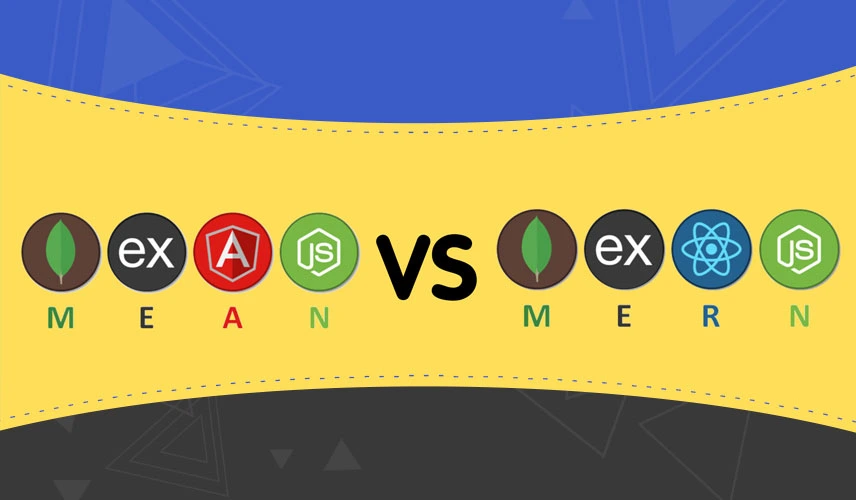
MEAN vs. MERN stack development Which should you choose for web app development?
In the digital age, everything is changing rapidly and we see many technological advancements and new market demands every day. So apps and websites aren't the only way to grow your business in the digital age. Choosing the right tech stack for your project requires a high degree of intelligence.
Choosing the right stack for your business can have a big impact on your long-term success. Which should I use? Which one works best?
Let's learn the differences and advantages of MEAN and MERN together.
- What is MEAN STACK?
- What is MERN STACK?
- MEAN Stack vs MERN Stack?
- MEAN Stack vs MERN Stack - How to Choose One?
- Conclusion
(1) What is MEAN stack?
MEAN is a very popular full-stack technology when building applications. "MEAN" define in four words M for MongoDB, E for Express, A for Angular, and N for Node.js.
MEAN Stack Development is fully based on Javascript. By the use of the MEAN stack, we develop web and mobile applications quickly. It offers a rapid development approach with excellent tooling and plugin support.
(2) What is the MERN stack?
MERN is another powerful open-source full-stack technology. MERN enables you to build great mobile web and hybrid apps using MongoDB, Express, React.js, and Node.js.
One of the main reasons for MERN's popularity is that it provides a consistent framework for the development process. Due to its growing popularity, MERN stack development provides developers with a complete framework.
(3) MEAN stack vs. MERN stack
Angular JS framework is already very popular due to its MVC architecture. However, not all web applications require an MVC design. Web applications can only optimize their component rendering code by using the UI layer abstractions. React JS is fully dependent on Js that meets this need.
The main difference between the MEAN and MERN stacks is the use of Angular JS and React JS libraries. Choosing between MEAN and MERN is a little more complicated, as both frames are dedicated to UI abstraction. On the one hand, Angular JS is backed by Google In, while React JS is a product of Facebook Inc.
Choosing the right stack means choosing this stack of popular technologies as the number of experienced developers grows.
The success of Angular and React fuels both the MEAN and MERN stacks. Angular used to be famous, but now React has surpassed it. The Stack-overflow Developer Survey 2019 also confirms that React is growing in popularity, and according to the survey, nearly 74.5% of developers prefer to build with React. For angles, the exact figure is 57.6%.
(4) MEAN Stack vs MERN Stack - How to Choose One?
The main difference between MEAN stack development and MERN stack development is Angular and React. Let's find out firsthand what the difference between them is.
1. Learning curve
MongoDB, Express, and Node.js are already popular and well-documented. I don't see much change in the learning curve in this regard. However, the learning curve varies from angle to response.
Angular is generic and uses typescript and templates. React is a library with a low learning curve, but it's definitely a steep learning curve. React also provides more comprehensive documentation than Angular, making learning more accessible.
2. Suitability
Since both the MERN and MEAN stacks are widely used, comparing the profitability of these two stacks reveals the difference between React and Angular. Since it is Node.js, Express and MongoDB are common.
Angular, a complete structure, increases profitability. Angular provides a CLI, which makes designers more efficient. You'll also find that using the Angular CLI makes it easier when it comes time to rewrite your code.
3. Workflow
In Angular scenarios, data flow is bi-directional. Changing the user interface automatically changes the model status. Things look a little different in React, where the data flow is one-way. When using React, the UI can only change when the state of the model changes.
4. Other Involvement support
Also, consider using third-party libraries when developing business-grade apps. MEAN includes corners with built-in functionality for HTTP requests and backend connectivity.
5. Acceptance
Undoubtedly, both developers are rapidly gaining popularity and many companies are using both frameworks to build various apps. It can be argued that there is no essential difference between MEAN and MERN. It's hard to choose one.
6. Proficient
If your development team is knowledgeable and familiar with the web framework, supporting documentation is less important. The learning curve that allows choosing the MEAN stack doesn't really fit here.
7. Achievement
The MEAN stack uses Angular to update the actual DOM (Document Object Model).DOM serves as a programming interface for XML and HTML documents.
React is used in MERN to update the virtual DOM. This is how you can code your apps faster with MERN.
8. MVC architecture
If you're designing a business-grade app, you need to stay on top of modern architecture. Therefore, you should choose the MEAN stack over the MERN stack.
MEAN has been a viable alternative for years and has a proven track record. This includes support for the MVC architecture, various support tools, and full coverage of the development cycle (front-side and client-side). This helps support the Model Viewing Controller architecture.
9. Long-term care
Both MEAN and MERN are robust open-source JavaScript-based web development tools. Popularity is the deciding factor. Both React and Angular are very popular. However, React is becoming more and more popular, making it easier for him to hire React engineers in the future.
10. Testing and Adjustability
The app testing experience is different from the React App Tester experience. This often influences MEAN stack development choices. Quickly test your Angular apps with just one tool like Jasmine.
Both MERN and MEAN stacks guarantee the highest security when it comes to security.
Conclusion
MEAN and MERN continues to be the leading full-stack technologies that enable the development of great applications. Both of these are growing in popularity and are powered by the Front Framework structure.


